More Bible stories in public schools, changes to history lessons before Texas education board today
Texas students may soon attend social studies and reading classes that minimize racial, geographic and cultural diversity while emphasizing the Bible.
The State Board of Education has two pivotal votes slated for this week that would usher in these changes: one on a rewrite of Texas’ social studies lessons, the other on a reading list for all public schools that includes teaching Christian stories.
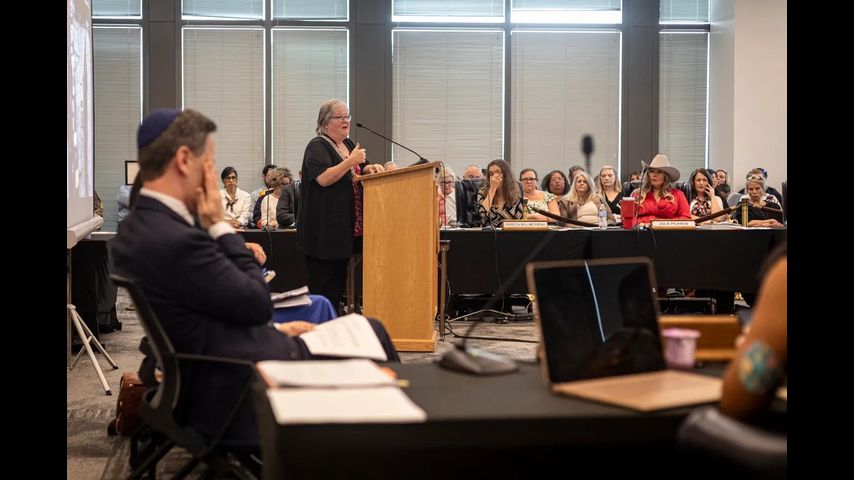
On Monday, board members heard from teachers, students and community members in support of and concerned about the lessons ahead of scheduled preliminary votes this week. A final vote on the changes is expected Friday.
Nearly 500 people signed up to testify in a hearing that at several points turned contentious, with heated exchanges between speakers and the removal of at least one person deemed out of order by the board chair.
The social studies proposal represents a dramatic transformation in how Texas schools have long administered lessons on history, geography, economics and government. It eliminates the current sixth-grade world cultures course, deemphasizes world history outside of European tradition and dedicates more focus to Texas and the United States.
The statewide reading list would require, among other literary works, that schools teach Bible stories to children as young as 6 years old up to young adults preparing to receive their diplomas.
If approved by the education board, both changes would take effect during the 2030-31 school year.
Conservative Republican leaders and activists champion the new lessons, which they view as “the final battle” in a push to rid Texas schools of instruction they say paints America in a negative light and trains students to hate the country.
Sociology classes, for example, currently require students to understand “the impact of race and ethnicity on society” and “analyze the varying treatment patterns of minority groups.” But that standard does not exist in the newly proposed social studies plan.
Republican leaders across the state often depict Islam as a violent religion they view as incompatible with their conservative Christian American values. During the board’s April meetings, the board eliminated a social studies standard that would have required students to learn about Muslim contributions to algebra and astronomy.
“Let me be very clear: Islam is not a religion,” Sen. Bob Hall, R-Edgewood, testified before the education board on Monday. “It is a totalitarian theocracy, not unlike totalitarian systems of communism, Nazism and globalism.”
Asked if he had ever visited a Muslim-majority country, Hall responded no.
Elizabeth Jensen, who identified herself as a Texas school board trustee but did not specify the district, told the education panel that she believes “slavery was and still is fundamental to Sharia,” referring to the set of moral codes and principles that Muslims follow. Sharia does not have a uniform meaning, as Muslims interpret and act upon it differently.
Muslims have spent months denouncing such Islamophobia at State Board of Education meetings, calling it misinformation and harmful to the hundreds of thousands of Texans who practice the faith.
Meanwhile, students, educators and progressive activists spoke out in opposition to the lack of racial, ethnic and gender inclusion in the debated books and lessons, as well as the state’s Christian focus over other religions.
“These proposed standards actually defy the Constitution and highlight only one group of Americans as the founders who built this country to the exclusion of others — both in the past and in the present,” Ruth Nasrullah, a Muslim speaker, told the board members.
English teachers stressed during the meeting that many of the books on the proposed reading list do not align with what Texas requires them to teach, despite taking up most of roughly 36 weeks of instructional time in an academic year.
On the other hand, educators criticize how the social studies proposal prioritizes memorization over critical thinking and simplification over accuracy. Historians call attention to factual errors, saying the new standards would set children up for failure post-graduation.
One lesson, for example, describes the forced relocation and imprisonment of Japanese families during World War II as one of the “contributions” to America’s military effort. Another proposal notes that high school students should know the significance of leaders in the Civil Rights Movement, specifying Thurgood Marshall, Barbara Jordan and Hector P. Garcia — but not Martin Luther King Jr.
A panel of nine advisers guided the social studies overhaul, almost all of whom hold no Texas K-12 classroom experience and several of whom have ties to conservative activism.
This article first appeared on The Texas Tribune.
More News